Dynjandi Waterfall, the Westfjords' Hundred-Metre Staircase
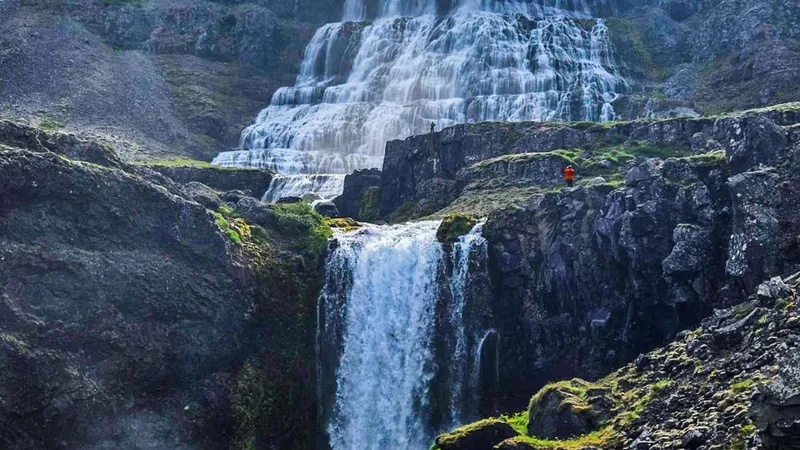
Seven falls stack up one mountainside at the head of Arnarfjörður, and the top one, Dynjandi waterfall, pours 100 metres of the Dynjandisá over black basalt. Compare the guided trips from Ísafjörður and book with free cancellation.
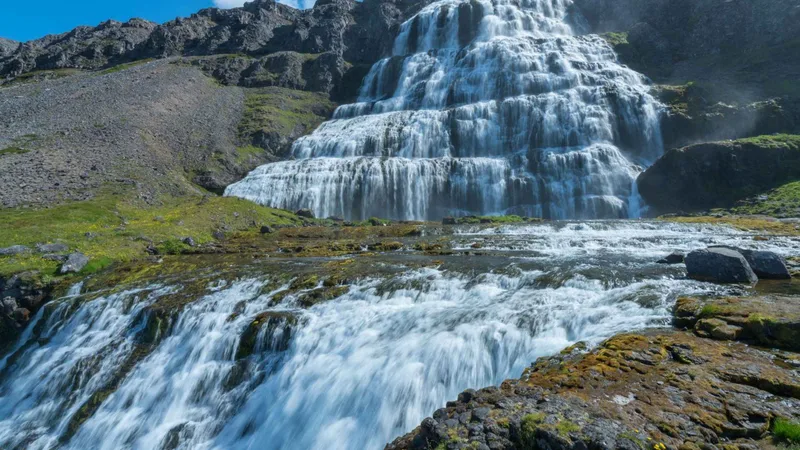
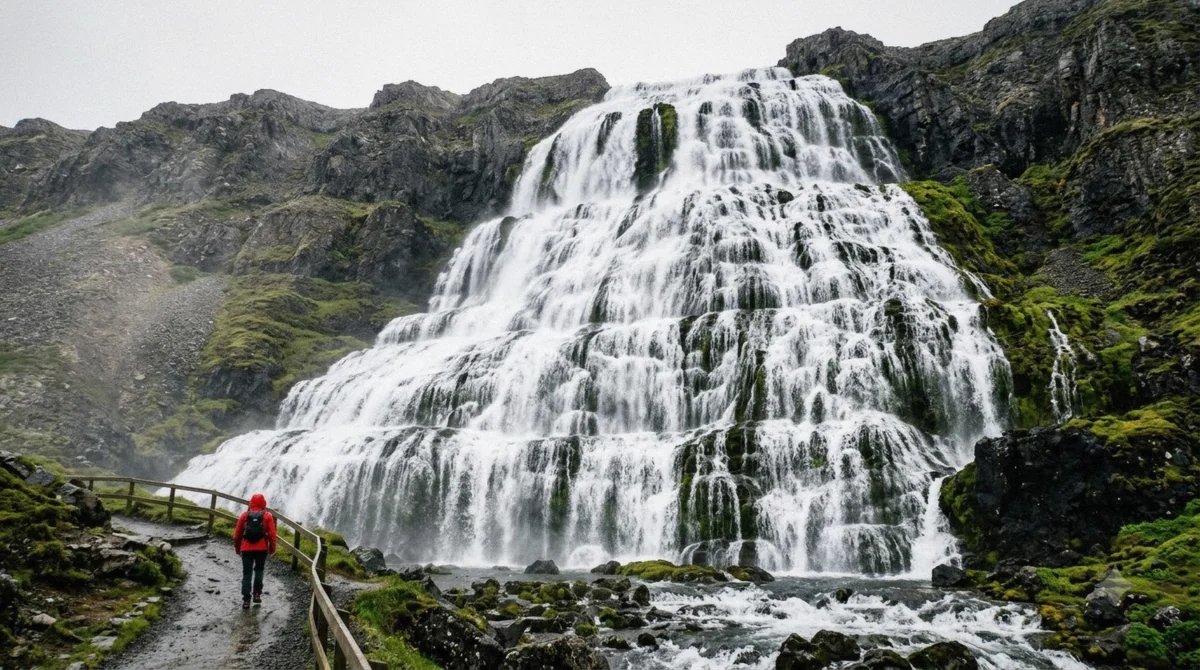
Dynjandi sits at the head of Arnarfjörður in the Icelandic Westfjords, 60 km south of Ísafjörður on Road 60, and drops 100 metres in a fan that widens as it falls. A path climbs from the car park to the base of the main fall in about 15 minutes, passing six smaller waterfalls. Guided trips from Ísafjörður run 3.5 to 4 hours and cost $79.71 to $205.
Key takeaways
Cheapest and most booked: the guided day trip by bus from Ísafjörður at $79.71 for 3.5 hours, rated 4.8 from 1,976 reviews, which is more reviews than the other eight trips here put together
Best for a cruise call: the farm shore excursion at $141.71, 4.7 from 1,353 reviews, with coffee and cake at a working farm on the way back and a schedule built around ship departure times
Full range runs $79.71 to $204.97 from Ísafjörður, plus a private superjeep at $801 for up to a car-load and a 3-day Westfjords trip out of Reykjavík at $1,103.41
Every trip here takes no payment today and cancels free up to 24 hours ahead, which matters on a road that shuts for weather
Driving yourself works from late May to October. Outside those months Road 60 over Dynjandisheiði closes under snow and a guided vehicle is the reliable way in
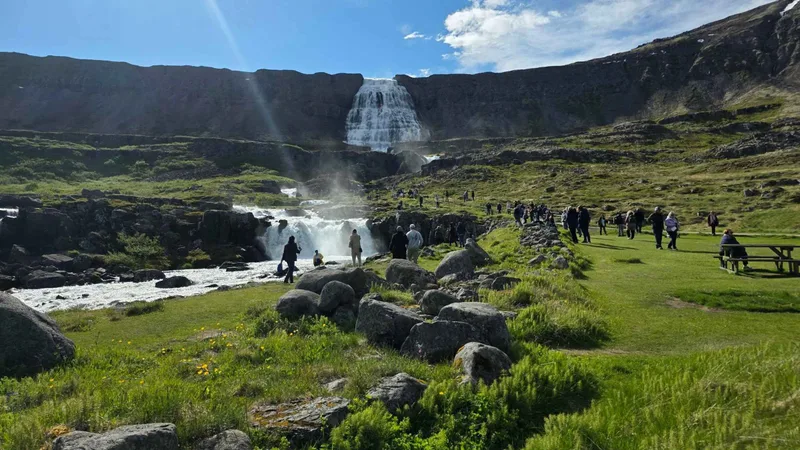
Facilities at the falls are toilets and picnic tables. There is no café, no shop and no ticket, since the site has been a protected natural monument in 1981 rather than an attraction with a gate
Free cancellation 24h
Reserve now, pay later
Pickup at the Ísafjörður pier
Local guides, small buses
100 mDrop of the main fall
6Smaller falls below it
15 minWalk from the car park
1981Protected as a natural monument
top pick
The Trip Most People Take
Dynjandi Waterfall Day Trip by Bus From Ísafjörður
★★★★★★★★★★4.8(1,976 reviews)
The half-day run most visitors take: a modern bus south on Road 60, a local guide on the microphone, and about an hour at the falls. The cheapest way to reach Dynjandi without a car.
Duration
3.5 hours door to door, roughly an hour at the falls
Meeting Point
Ísafjörður, a short walk from the cruise pier and the town centre
Included
Bus, local guide, the drive over Dýrafjörður and along Arnarfjörður
Price Range
$79.71 per person, the lowest price of any Dynjandi trip on this page
Live availability for the $79.71 half-day trip. Departures cluster around cruise calls between June and August, and the morning bus fills first on days when two ships are in port.
Eight of these nine leave from Ísafjörður and take half a day. They differ in what they add on the way back: a farm and cake, a stop with Icelandic horses, the fishing village of Flateyri, or a superjeep track that ordinary buses cannot use. The ninth is a 3-day loop from Reykjavík that reaches Dynjandi on the second day.
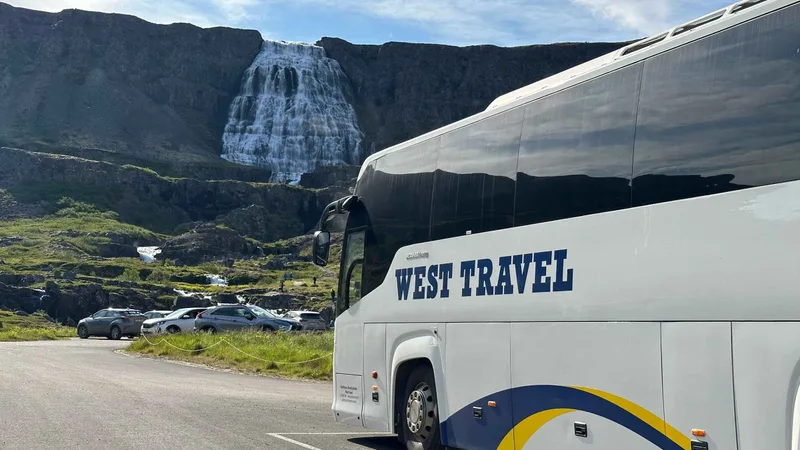
from $79.71Most Reviewed — 1,976 Reviews
Dynjandi Waterfall Day Trip by Bus From Ísafjörður
★★★★★★★★★★4.8(1,976 reviews)· 3.5 hours
The half-day run most visitors take: a bus south on Road 60, a local guide on the microphone, and about an hour at the falls.
Three ways reach the falls and the right one depends on the month and where you are sleeping. Between June and September a rental car is straightforward and the cheapest option for two or more people. From November to April the mountain road decides for you.
Way in
Season
Time
Book
Cost
Suits
Guided trip from Ísafjörður
All year, heath detours in summer
3.5 to 4 hours
$79.71 to $204.97 pp
Cruise calls, no car
Rental car on Road 60
Late May to October
About an hour each way
Fuel plus rental day
Two or more, flexible day
Private superjeep
All year, including snow
3.5 hours
$801 per vehicle
Families, winter, mobility limits
3-day trip from Reykjavík
Summer only
3 days
$1,103.41 pp
The whole region, not one stop
Dynjandi by the Numbers
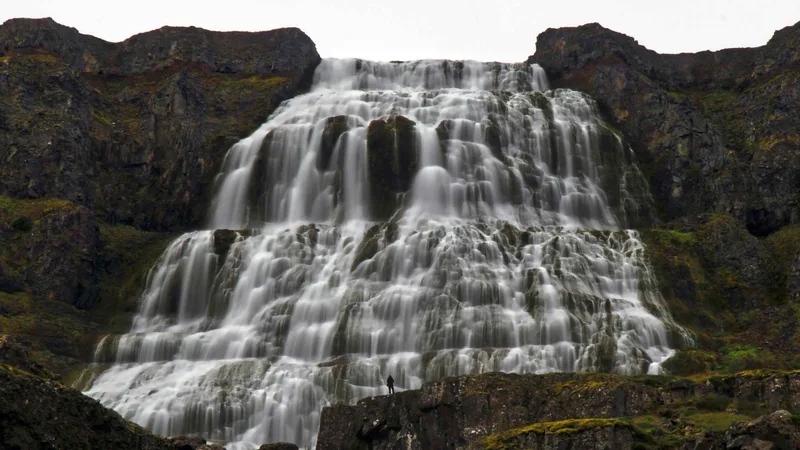
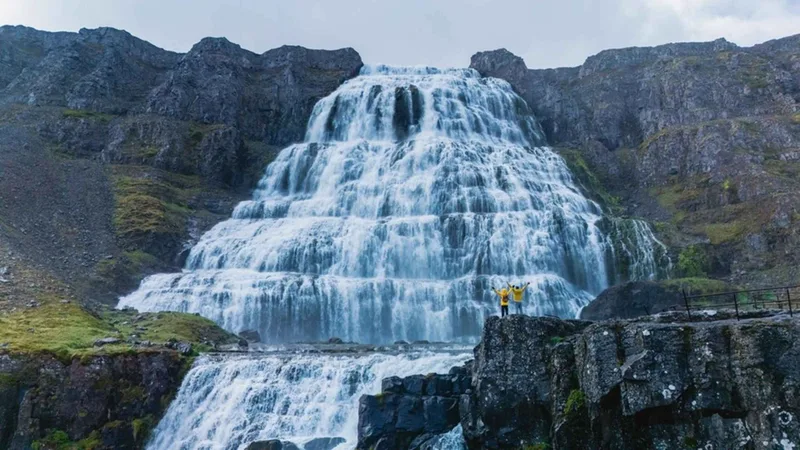
The shape is what people remember. Water enters the top of the fall through a narrow gap and leaves the bottom across a face twice as wide, which is why photographs of it look like a bridal veil or a flight of stairs depending on the light.
100 metresTotal drop of the main fallThat makes it the largest waterfall in the Westfjords, though not the tallest in Iceland. Height alone undersells it, because the water spends the whole descent spreading sideways
30 to 60 mWidth at the top and the baseIt measures about 30 metres at the top and roughly 60 metres where it meets the lower slope, the ratio that gives the fall its trapezoid silhouette
7Falls in the chainThe main drop plus six smaller waterfalls stacked below it on the Dynjandisá, each with its own name, all inside a 15-minute walk
200 mElevation gained on the pathThe trail climbs about 100 metres from the car park to the viewing area at the foot of the main fall, roughly 1.8 km there and back. The first stretch is paved and level, the upper half is loose rock and steps
1981Year the falls were protectedDynjandi and the other waterfalls on the river were declared a natural monument in 1981, which is why there is no visitor centre, no lighting and no fence
5.6 kmLength of the tunnel that changed the driveDýrafjarðargöng opened in 2020 and cut 27.4 km off the route between Dýrafjörður and Arnarfjörður, turning a seasonal mountain crossing into a year-round road
Everything Worth Knowing Before You Go
What Dynjandi Actually Is
The name means thunderous, and you hear the fall before the road turns the corner and shows it to you. Icelanders also call it Fjallfoss, the mountain fall, which is the name you still see on older maps and road signs.
Water comes off the highland plateau above Arnarfjörður as the river Dynjandisá, then meets a hillside built in layers. Hard basalt from old lava flows sits above softer rock, and over thousands of years the river carved the soft bands out and left the hard ones standing. The result is a staircase rather than a single plunge. Every step widens the flow a little more, so a river that arrives 30 metres across at the top leaves the bottom of the main fall around 60 metres wide.
That one detail explains why Dynjandi photographs so differently from Iceland's famous single-drop waterfalls. Skógafoss is a column. Dynjandi is a slope of white water, and in low sun the individual lava layers throw shadows across it.
The Six Falls Below the Big One
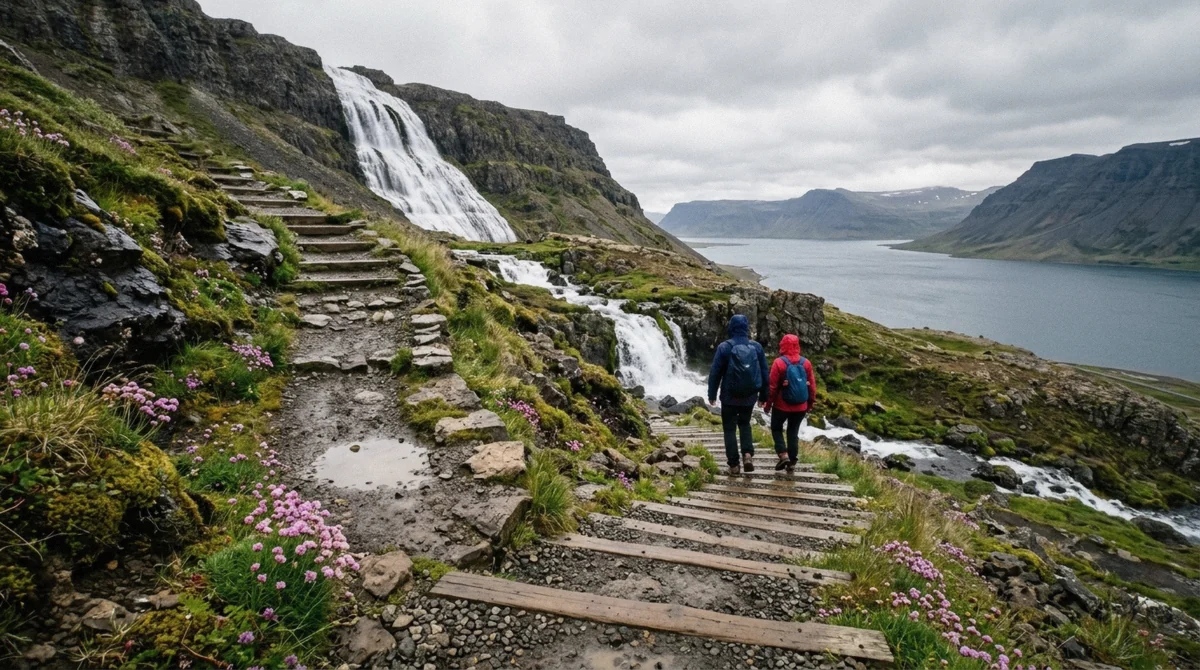
Most visitors walk up looking at the top of the hill and miss what they are climbing past. Six smaller waterfalls sit on the same river below the main drop, and the path threads between them.
From the car park upward they run Bæjarfoss, also called Sjóarfoss, then Hundafoss, Hrísvaðsfoss, Göngumannafoss, Strompgljúfrafoss and Hæstahjallafoss, the last one just below the main fall. Names vary between sources and even between signs, and a seventh, Kvíslarfoss, sits on a side branch further down. Locals disagree about the exact list, which tells you something about how long people have been walking up here.
Göngumannafoss is the one worth stopping at. It drops into a bowl you can stand beside, and on a still day the spray hangs there instead of blowing off.
The Walk From the Car Park
Allow 15 minutes up and about the same back down, or 30 minutes round trip at a steady pace. Add another half hour if you stop at each of the lower falls, which most people end up doing.
The path climbs about 100 metres over roughly 1.8 km round trip, and it is fenced most of the way to protect the vegetation. The lowest section is paved and flat enough for a wheelchair or a pushchair as far as the first viewpoint. Above that it turns to packed gravel, then loose stone with built steps on the steepest pitches. Nothing about it is technical, but it is uneven, and it is often wet from spray.
Wear boots or trainers with grip. Trail runners and smooth-soled shoes slide on the wet rock near the top. There is no railing at the base of the main fall and no barrier between the path and the drop on the outside edge, so keep children close.
About 15 minutes to the base of the main fall, 30 minutes there and back
About 100 metres of climb over 1.8 km round trip, paved at the bottom, loose stone at the top
Wet rock near the fall in any weather, so grippy soles beat fashion boots
Wind funnels down the valley, so a shell layer earns its space in the bag
No railings, no lighting and no phone signal in parts of the valley
Getting There on Road 60
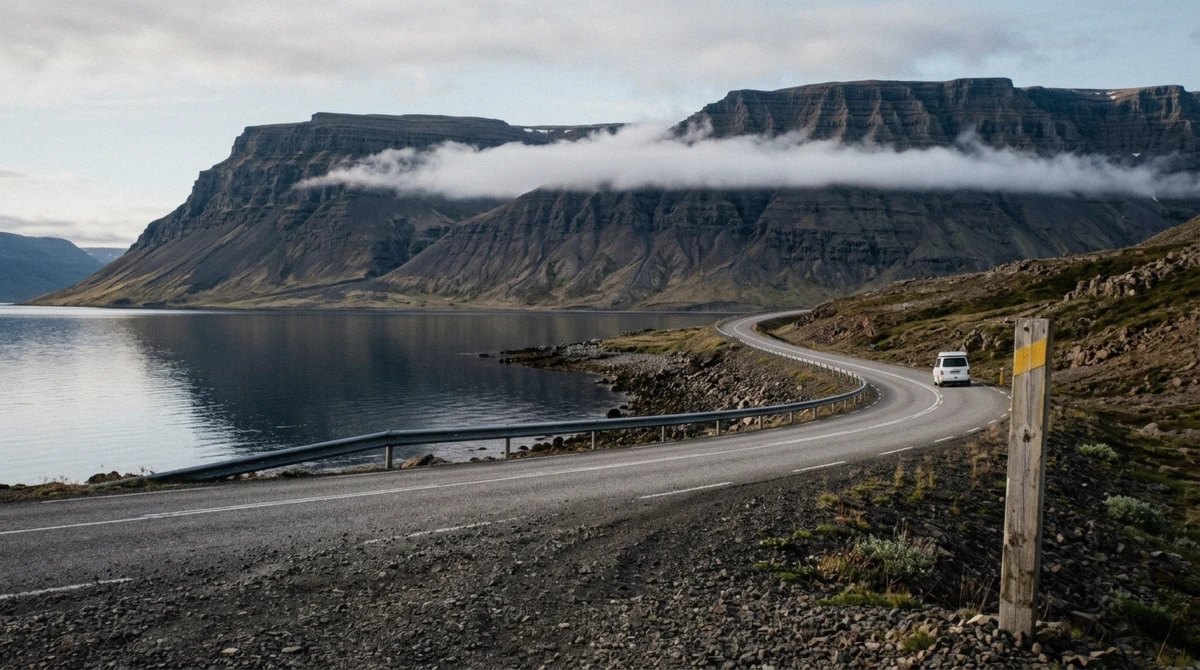
Dynjandi sits on Road 60, the main Westfjords route, about 60 km south of Ísafjörður. Driving takes an hour to an hour and a half depending on how much of the road is gravel that season and how often you stop for the view over Arnarfjörður, which you will.
From Reykjavík it is roughly 356 km and a 5-hour drive, more if you take the ferry across Breiðafjörður or detour to Látrabjarg. The last stretch to the car park is gravel, graded but washboarded in places, and normal rental cars handle it at sensible speed.
The 2020 opening of Dýrafjarðargöng, a 5.6 km tunnel between Dýrafjörður and Arnarfjörður, took 27.4 km off the northern approach and removed one high mountain pass from the drive. Anyone comparing this trip against a guidebook printed before then is reading old timings.
When the Road Opens and When It Shuts
Dynjandisheiði, the heath south of the falls, tops out around 500 metres and takes the weather that comes with that. Snow closes it through winter and it reopens somewhere between late March and May depending on the year. For a self-drive visit, plan on late May to October and treat anything outside that as a bonus.
Check road.is, run by the Icelandic Road Administration, on the morning you travel. Conditions change inside a few hours in this part of the country, and a road marked green at breakfast can be marked impassable by lunch.
Water volume peaks with the snowmelt in June and stays strong through July, and the month-by-month picture covers flow, daylight and crowds together. By late September the flow drops and the fall gets more transparent, showing more of the rock behind it. Both are worth seeing. Neither is worth a closed road.
Season
Road 60 over the heath
The falls
Getting there
June to August
Open, busiest, longest daylight
Peak flow from snowmelt
Drive or take a half-day trip
September to October
Usually open, weather-dependent
Lower flow, autumn colour on the slope
Drive early in the day
November to March
Often closed under snow
Ice on the lower falls
Guided vehicle or superjeep
April to late May
Reopens, dates vary each year
Melt starting, strong flow
Check road.is before committing
Visiting From a Cruise Ship
Ísafjörður takes cruise calls through the summer and the pier sits five minutes from the town centre, so the logistics are simpler here than in most Icelandic ports. Shore excursions to Dynjandi run 3.5 to 4 hours and are built around ship departure times, which is the reason to book one of these rather than hail a taxi.
The farm version stops for coffee and cake at a working farm on the way back and holds 1,353 reviews at 4.7. The Flateyri versions add a village of about 200 people with a bookshop that has been trading since 1914. The 6-hour Bolungarvík trip goes further and suits a long port call rather than a short one.
If your ship is in port for six hours or less, take the 3.5-hour option and keep the buffer. The road has one lane in places and a slow camper van sets the pace for everyone behind it.
The Farm at the Bottom of the Falls
The flat ground below the car park is not empty by accident. A turf farm stood here, worked until 1951 and pulled down in 1970, and archaeologists have recorded 38 separate remains on the site, some dating to the Middle Ages.
One of them still works. Dynjandislaug, a lukewarm pool fed by a spring, was measured at 26.5 degrees Celsius in 1887 and 23.5 degrees in 1996. It is not a bathing spot and it is not signposted as one, but it explains why anyone chose to farm at the foot of a waterfall this loud.
Stand at the old farm mound and look up. That is the view the family living here had every day for generations, and it is the reason the whole valley, not only the waterfall, carries protected status.
What Else Is on This Road
Nobody drives four hours for one waterfall, and the route gives you reasons not to. Hrafnseyri, on the north shore of Arnarfjörður, is the birthplace of Jón Sigurðsson, the man on the 500-krónur note and the leader of Iceland's independence movement. The museum and turf church there open in summer.
Flateyri, out on its own spit in Önundarfjörður, holds around 200 residents, an avalanche barrier above the village you cannot miss, and the oldest original shop in Iceland. Several tours on this page stop there.
Compared with Gullfoss or Seljalandsfoss on the ring road, Dynjandi stays quiet. Reaching the Westfjords takes a deliberate detour, and that filter does more for the experience than any visitor management scheme could.
One River, Seven Drops
The path from the car park climbs past every fall in the chain. Listed here from the top down, the way you see them from the road below.
Dynjandi (Fjallfoss)100 mThe main fall. About 30 metres at the top, roughly 60 metres across at the base
Hæstahjallafossthe highest stepSits just below the main drop, the first one you reach on the climb
Strompgljúfrafossgorge fallCuts into a narrow slot in the rock, also recorded as Strompur
Göngumannafosswalker's fallFalls into an open bowl beside the path, the best stop on the way up
Hrísvaðsfossmid-slopeEasy to walk past without noticing it from the upper path
Hundafossdogs' fallWide and low, loudest of the smaller falls after heavy rain
Bæjarfoss (Sjóarfoss)the farm fallThe one nearest the car park, named for the turf farm that stood beside it
Names and spellings differ between the official signage, older Icelandic sources and Wikipedia. Kvíslarfoss, on a side branch of the river, brings some counts to eight.
Where Dynjandi Waterfall Is
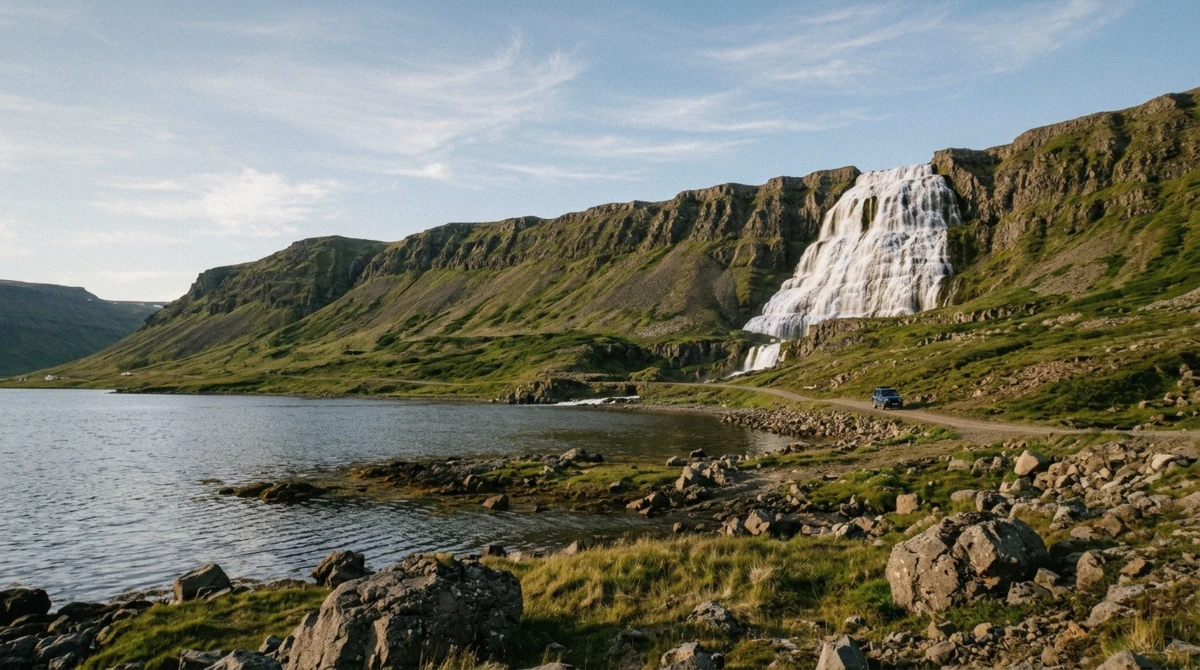
At the head of Arnarfjörður on Road 60, 60 km south of Ísafjörður and about 356 km from Reykjavík. The car park sits at 65°44'N 23°12'W, right below the falls.
Water, Daylight and the Road, Month by Month
Bars show average rainfall at the head of Arnarfjörður in millimetres, with the average daytime high in degrees Celsius under each month. The colour marks whether Road 60 over Dynjandisheiði is a reliable drive.
95mmJan1°C
82mmFeb1°C
80mmMar2°C
62mmApr4°C
48mmMay7°C
42mmJun10°C
45mmJul12°C
55mmAug11°C
75mmSep8°C
92mmOct5°C
95mmNov2°C
98mmDec1°C
Road open, tours run daily
Opening or closing, check road.is
Heath often closed under snow
Ísafjörður gets around 20 hours of usable light in June and barely four in December, which matters more than the temperature when you plan the drive.
What the Ratings Say
Nine Trips, 4,187 Reviews Between Them
None of the operators here runs a bad trip, which the numbers bear out. The bus day trip carries 4.8 from 1,976 reviews, the largest sample by a wide margin and the reason it appears first on this page. The farm shore excursion sits at 4.7 from 1,353. The horses and country church version rates 4.5 from 706, the lowest of the three big ones and still comfortably above the Iceland day-tour average.
The smaller counts need reading with care. A 5.0 from four reviews and a 4.8 from fourteen tell you the operator has not had an unhappy customer yet, not that the trip beats one with two thousand reviews behind it. The Bolungarvík excursion at 4.3 from 28 reviews is the one to look at closely, since a six-hour schedule leaves more room for something to run late.
What reviewers complain about, when they complain, is weather and time at the falls rather than guiding. An hour on the ground is enough to reach the base of the main fall and get back, and not enough to also sit and eat lunch.
What People Wrote After Going
★★★★★★★★★★
A great trip. Sally, our guide, was very knowledgeable and informative. It was a clean and comfortable ride there and then the perfect amount of time to get all the way up and back again. Pretty much identical to the tour the cruise ship offered at a fraction of the price.
Alex · United Kingdom · July 2026
★★★★★★★★★★
Dynjandi waterfall was gorgeous and worth the hike up to the top with several stopping points along the way. The stop at the farm was also great. The family who owns the farm served cake and coffee and explained how they raised and herded the sheep.
Veena · United States · July 2026
★★★★★★★★★★
This was an excellent experience. The Dynjandi waterfall was an amazing sight to behold. If you're adventurous enough, definitely go all the way to the base of the main waterfall, it is such a great experience.
Robert · Canada · July 2026
The view that stops every car on Road 60. The falls face north across Arnarfjörður, so afternoon and evening light hits them straight on.
Reading These Trips Before You Book
Time at the falls, not total hours
A 4-hour trip and a 3.5-hour trip usually give the same hour at the waterfall. The extra half hour buys a village or a farm stop on the way back.
Bus size decides the road
Large coaches stick to the paved route. Small buses and superjeeps can take the heath roads over Hrafnseyrarheiði, which is where the fjord views are.
Cruise timing is built in
Shore excursions sold through the operators here are scheduled against ship departures. A private taxi is not, and the road gives you no way to make up lost time.
Nothing is included at the site
There is no ticket to buy and nothing to skip the queue for. What you pay for is the drive, the guide and the seat, so compare on those.
Winter needs the right vehicle
Between November and March the question is not price but whether the vehicle can cross the heath. The superjeep exists for exactly this.
Free cancellation is worth using
Every trip here cancels free 24 hours out. Book the date you want early in the season, then watch the forecast rather than gambling on availability.
What You Pass on the Way From Ísafjörður
The 60 km drive south crosses two fjords and a tunnel before Arnarfjörður opens up and the falls appear at the far end of it.
ÍsafjörðurDeparture point, pier five minutes from the town centre
ÖnundarfjörðurFlateyri sits on the spit, about 200 residents and a shop trading since 1914
Dýrafjarðargöng5.6 km tunnel opened in 2020, cutting 27.4 km off the old route
HrafnseyriBirthplace of Jón Sigurðsson, museum and turf church open in summer
ArnarfjörðurThe long fjord the falls drop into, flat-topped mountains on both shores
DynjandiCar park, toilets, then a 15-minute climb past six smaller falls
Several trips return over Hrafnseyrarheiði or Álftamýrarheiði instead of the tunnel. Those heath roads open in summer only and are the reason to pick a small vehicle.
Questions People Ask Before They Go
Is Dynjandi waterfall worth it?
Yes, and the walk is the reason. Seeing 100 metres of water fan out across black rock from the road is one thing. Climbing past six smaller falls to stand at the base, where the spray reaches you and the noise makes conversation pointless, is another. Set against the effort of reaching the Westfjords at all, an hour here is the payoff for the whole detour. If you are already in Ísafjörður, the $79.71 bus day trip makes the decision easy.
How long is the hike to Dynjandi?
About 15 minutes from the car park to the base of the main fall, roughly 30 minutes there and back over about 1.8 km, climbing around 100 metres. Most people take an hour because they stop at the lower falls. The first section is paved and level, then it becomes packed gravel and built stone steps. It is uneven and often wet, so wear shoes with grip.
What is the most beautiful waterfall in Iceland?
Icelanders argue about it and Dynjandi wins more of those arguments than its visitor numbers suggest. Gullfoss carries more water and Seljalandsfoss lets you walk behind it, but neither has the tiered shape that widens from 30 metres at the top to about 60 metres at the base. Add a fjord below and no crowd in front of you and the case gets strong.
How do you get to Dynjandi waterfall?
By Road 60, which runs the length of the Westfjords. From Ísafjörður it is 60 km south, an hour to an hour and a half, through the Dýrafjörður tunnel and along Arnarfjörður. From Reykjavík it is about 356 km and a 5-hour drive. Without a car, take a guided trip from Ísafjörður, which is what most visitors do. The six-hour route via Bolungarvík covers the north side as well.
Where is Dynjandi waterfall located?
At the head of Arnarfjörður in the Westfjords of northwest Iceland, on the river Dynjandisá, at 65°44'N 23°12'W. The car park sits directly below it on Road 60. The nearest town is Ísafjörður, 60 km north. It is the largest waterfall in the Westfjords and has been a protected natural monument in 1981.
Can you visit Dynjandi from a cruise ship in Ísafjörður?
Yes, and it is the most common way people see it. Shore excursions run 3.5 to 4 hours and are timed against ship departures. The pier sits a five-minute walk from the town centre, so there is no transfer to factor in. For a port call of six hours or less, take a 3.5-hour departure, or the four-hour run that adds Flateyri, rather than the six-hour Bolungarvík version.
Is the road to Dynjandi open in winter?
Often not. Dynjandisheiði climbs to around 500 metres and closes under snow through the winter, reopening between late March and May depending on the year. Check road.is on the morning you travel. Between November and March a private superjeep or a guided vehicle is the reliable way in, and a rental car is not.
Do you need a tour, or can you drive yourself?
From late May to October you can drive yourself in a normal rental car, and for two or more people that costs less than seats on a bus. Outside those months, or on a cruise call, book a trip. Guides watch the road reports, carry the right vehicle for the heath, and get you back before your ship leaves. The farm and countryside trips add coffee and a working farm to the same half day.
How far is Dynjandi from Reykjavík?
Around 356 km by road, which works out at a 5-hour drive without stops, longer if you use the Breiðafjörður ferry. Nobody does it as a day trip. Either stay a night in the Westfjords or take the 3-day guided loop from Reykjavík, which covers Dynjandi along with Látrabjarg and Rauðasandur.
Are there toilets and parking at Dynjandi?
There is a car park at the foot of the falls, reached by a short gravel stretch off Road 60, and toilets that stay open through the year. There are picnic tables. There is no café, no shop and no visitor centre, so bring water and food with you. Parking has been free, though one 2025 visitor account reports a card-only charge, so carry a card. Last verified July 2026.
Your guide
Sigrún Halldórsdóttir
Guide and driver, Ísafjörður · driving the Road 60 run to Dynjandi since 2013
Thirteen summers of driving visitors south over Dynjandisheiði and back, and enough winters watching the heath close to know when the forecast is lying. Grew up in Ísafjörður, checks road.is before coffee, and will tell you to skip a departure rather than sell you a wet hour in the car park.
Ready to stand at the bottom of it? Compare the departures from Ísafjörður and pick your date.
 from $79.71Most Reviewed — 1,976 Reviews