Best Time to Visit Dynjandi Waterfall: Month by Month

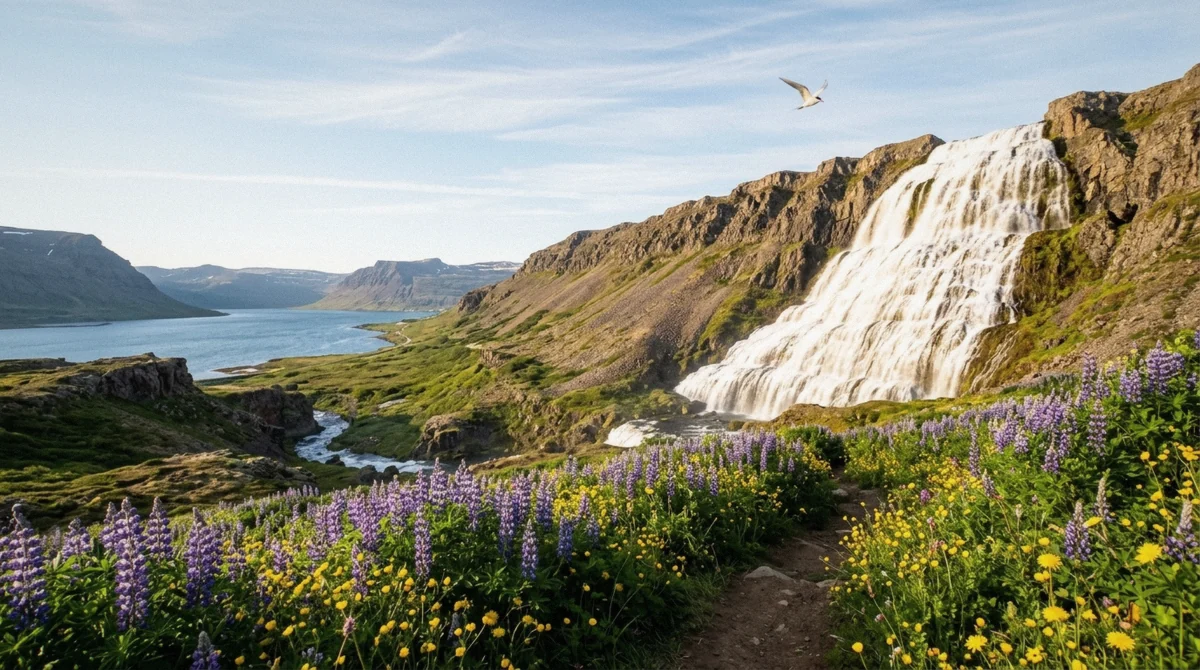
June through August is the best time to visit Dynjandi waterfall, when snowmelt pushes the flow up to about 8 cubic metres a second and daylight barely ends near the summer solstice. September and October run a distant second, quieter and cooler with less water coming down. Late October through April is the window to avoid entirely; the road over the heath closes under snow and the falls drop to a trickle. I've watched this river swing between those two states for over a decade of driving guests south on Road 60, and the month you pick changes more about the visit than almost anything else, including which of the Dynjandi waterfall departures by month actually run that week.
Quick answer
The best time to visit Dynjandi is June through August, when snowmelt pushes the flow toward its summer peak and daylight runs nearly around the clock near the solstice. September and October are the reasonable runner-up, with lower water but far fewer people.
Key takeaways
- Best window: June through August, for peak flow and the longest daylight of the year
- Runner-up: September and October, trading some water volume for thinner crowds and autumn colour
- Month to avoid: November through April, when the road over the heath is normally closed under snow
- Counterintuitive fact: flow swings roughly eightfold between summer and winter, from about 8 cubic metres a second down to about 1
- Best time of day: afternoon or evening, since the falls face west
- Crowds spike on the days two cruise ships call at Ísafjörður, regardless of the month
Seasons at a Glance
Reading the Table
The Verdict column below is the short version. Road status covers the practical self-drive season, typically late May to October; flow describes the river itself, which runs fullest on snowmelt in early summer and thins toward winter.
Month-by-Month
| Month | Road Status | Water Flow | Book | Daylight | Crowds |
|---|---|---|---|---|---|
| January | Closed, snow over the heath | Low, around 1 m³/s, ice on the lower falls | Short, sun absent from Ísafjörður itself until 25 January | Low, effectively no visitors | |
| February | Closed, snow over the heath | Low, still winter minimum | Growing quickly through the month | Low | |
| March | Usually closed, has opened as early as 29 March in past years | Low to rising | Near equal day and night by month end | Low | |
| April | Reopening most years, sometimes not until May | Rising with early snowmelt | Long and growing fast | Low | |
| May | Open most years by late May | Rising toward peak | Very long, near-continuous light building | Low to moderate | |
| June | Open, full self-drive season | Peak, up to about 8 m³/s | Near-continuous light around the solstice | Moderate to high, cruise season begins | |
| July | Open | Peak flow continues | Very long, midges possible on still days | High, peak cruise calls at Ísafjörður | |
| August | Open | Still strong, easing slightly | Long, noticeably shortening by month end | High, cruise season continues | |
| September | Open | Lower, past peak snowmelt | Shortening quickly | Moderate, tour numbers thin out | |
| October | Open into the month, closing risk rises late | Lower still, autumn rain can bump it briefly | Short, closing in fast | Low to moderate | |
| November | Closing under snow | Low | Short | Low, near end of season | |
| December | Closed, snow over the heath | Low, winter minimum approaching | Shortest of the year, sun gone from Ísafjörður by late November | Low |
June, July and August are effectively tied for the fullest flow and the widest choice of tours; the real trade between them is crowding, not water. October is the last realistic month for a self-drive visit most years, and even then the road can close early if snow arrives sooner than usual.
Temperatures and Rainfall
| Month | High | Low | Book | Rain |
|---|---|---|---|---|
| January | Coldest of the year, about 1 to 2°C | Below freezing | High | |
| February | Similar to January, near freezing | Below freezing | High | |
| March | Starting to climb | Still below freezing most days | Moderate | |
| April | Rising steadily | Around freezing | Moderate | |
| May | Mild, comfortable for the walk up | Above freezing | Moderate | |
| June | Warm by local standards | Cool | Low, around 42 mm | |
| July | Warmest of the year, about 10 to 12°C | Cool but comfortable | Low | |
| August | Similar to July, easing slightly | Cool | Moderate | |
| September | Cooling steadily | Chilly mornings | Moderate | |
| October | Falling toward winter | Near freezing | Moderate to high | |
| November | Cold | Below freezing | High | |
| December | Cold, among the wettest months | Below freezing | High, around 98 mm |
These are typical patterns for the head of Arnarfjörður, not a guarantee for any single day, consistent with figures published by the Icelandic Meteorological Office (vedur.is); check the current forecast close to your dates. December runs wettest at around 98 mm and coldest, with highs near 1 to 2°C; July runs driest and warmest, with highs around 10 to 12°C.
Best Season by Traveler Type
If you want the fullest waterfall for photos
come in June or July, when snowmelt has the flow at its highest
If you'd rather avoid the biggest crowds
aim for September, after cruise season thins out but before the road risks closing
If this is your one shot and you want the safest bet against a closed road
stick to July or August, the two months least likely to see any weather disruption
If midges bother you
avoid still, windless days in July, or shift your visit to a breezier month like September
If budget and quiet matter more than peak flow
late September or early October gives decent water with a fraction of the summer traffic
Summer (June to August): Peak Flow, Longest Days
This is the full self-drive season and the only stretch of the year when every operator is running. Daytime highs sit around 11 to 12°C, and daylight is long enough near the solstice that timing barely matters. The trade is crowding: cruise calls at Ísafjörður peak in July, and the car park and every tour schedule feel it. The bus day trip from Ísafjörður runs daily through this stretch, and booking a few days ahead is worth it in the busiest weeks.
Autumn (September to October): Lower Water, Real Quiet
Flow drops off from its summer peak, and the surrounding slopes pick up autumn colour. Crowds thin fast once cruise season winds down in September, and highs cool to single digits by October. The road is still open through most of October in a typical year, though the risk of an early closure rises as the month goes on. The private superjeep is worth considering here, since it keeps running if conditions turn marginal earlier than expected.
Late Spring (May): The Road Reopens
May is a genuine gamble some years and a quiet gift in others. The road typically opens by late May, though it has opened as early as late March in a good year and stayed shut into May after a hard winter. Flow is rising but not yet at its summer peak, and crowds are close to nonexistent.
If your dates are flexible, checking road.is a week out is the only way to know what May will actually give you.
Winter (November to April): Plan Around It, Don't Plan For It
Road 60 is normally closed to ordinary traffic through this stretch, and flow drops to close to its winter minimum. I won't promise exact closing or reopening dates here since they shift every year with the snow; treat November through April as off the table for a standard visit and check current conditions if you're determined to try anyway.
What Actually Affects Conditions
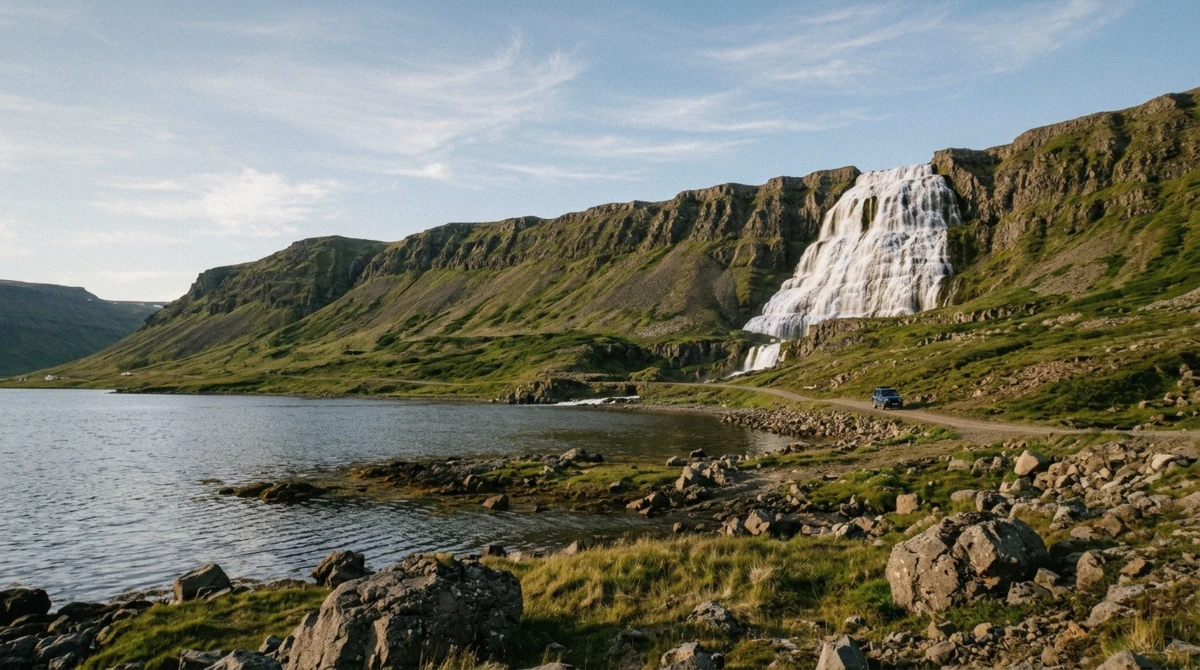
Most people assume rain drives the flow at Dynjandi. It's actually snowmelt that does the real work. The river Dynjandisá is fed from the high ground above the fjord, so the biggest jump in volume comes each spring as the winter snowpack melts, not from any single rain event.
That's why June and July, not the wettest months, carry the fullest water: the snowpack is still releasing through early summer even as rainfall itself eases off.
Best Time of Day
Afternoon and evening beat morning here, and it isn't close. Dynjandi faces west, so a morning visit puts the sun behind the falls and flattens the shot; by afternoon the light comes around onto the face of the water. This holds through the whole practical season.
The one exception is a still July evening, when midges can be worse right at the golden hour than they are earlier in the day, so plan for a head net if you're chasing that light.
Crowds and Prices Through the Year
Crowds at Dynjandi track cruise calls at Ísafjörður more than they track the calendar. On a day when two ships are in port, every operator drives the same road at the same time, and the car park fills for an hour or two around midday regardless of whether it's June or September. A quiet Tuesday in peak July with no ship in port can feel emptier than a Saturday in late September with two ships calling.
If you're driving yourself, checking the day's cruise schedule matters more than checking the month. I've had mornings in the supposed high season where I had the lower viewing platform to myself for ten minutes straight, simply because no ship happened to be docked that day, and I've also arrived on a quieter-looking September date to find two coachloads already parked ahead of me.
June through August gives the fullest waterfall and the longest days, at the cost of the year's biggest crowds. September trades a bit of that water for real quiet and is the better call if crowds bother you more than flow does. Avoid November through April altogether unless you're chasing a superjeep trip built specifically for winter conditions; the road, not the waterfall, is what rules out that stretch of the year.
Once you've picked a month, how to get to Dynjandi waterfall covers the drive itself, and is Dynjandi waterfall worth it walks through what you'll actually find once you're standing in front of it.
Timing Your Visit
How much time should I spend at Dynjandi?
Most visitors spend 45 minutes to an hour and a half at the falls, depending on how far up the path they go and how long they linger. Shore excursions typically build in 45 to 90 minutes; self-drivers can stay as long as they like.
What is the best month to visit Dynjandi?
July, if peak flow and reliable road access matter most. September is the better pick if you'd rather trade some water for a much quieter visit.
Is Dynjandi worth it in September?
Yes. The flow has eased from its summer peak, but it's still a real waterfall, not a trickle, and the crowds thin out noticeably once cruise season winds down. Autumn colour on the slopes is a genuine bonus most visitors don't expect.
When does the road to Dynjandi open?
Usually around late April, sometimes as early as late March in a mild year; it opened on 29 March in 2017, and stayed closed into May in 2015 after a hard winter. Check road.is close to your travel dates rather than relying on any fixed date.
Does it matter if it rains during my visit?
Not much. Rain adds to the river rather than ruining the view, and the falls already throw spray regardless of weather. A real snag would be a closure over the heath, which is a road issue rather than a rain issue.
Are midges a problem year-round?
No, they're mainly a still-day, July phenomenon on the walking path. A breeze usually clears them, and they're rare outside the warmest weeks of summer.